What crosses the Flood?
A warning passes through a reed wall. Condemned Watchers ask a scribe to speak for them. Two pillars carry a record of the stars. Ancient writers imagined quite different ways for a message to outlive its world. These stories meet to a plate on which three small figures stand beneath a banded, flowerlike head. In his reading, someone has built an instrument to receive a signal.
Passages and witnesses
Where to start on the plate
Look at the right column, where Zeva- ends one line and maim begins the next. In paragraph 2.3 of the digital interlinear, the project renders zevamaim as “propagating ones.” In paragraph 3.2, the lower block pairs nifog taloz with nifog yonoh. The interlinear proposes a concealed, lifted sphere and a dark, deep realm. These are two different passages. Putting the senders on the sphere is an act of composition. The image itself comes to us as a digital illustration in a Forgotten Languages post. Its towers carry no legible city names. Original plate · Working interlinear · Annotated reading
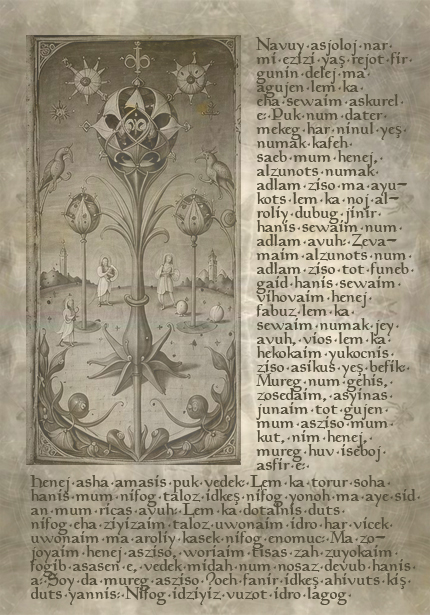
The project’s language notes compare a proposed Steppe grammatical layer, Semitic consonant patterns and Indo-Iranian vocabulary. Readers can check the repeated spelling nifog directly. Assigning it an English meaning, tracing that meaning across languages and placing a community in Rajasthan each require a further argument. The comparative notes explain how the project arrived at those proposals. The picture supplies a different starting point. What happens if the two bands of text and the two buildings on the horizon belong to different times in the same story? Project’s linguistic strata · Plate in context
Before the water, and afterward
Genesis 6:1–4 puts divine beings, human daughters, Nephilim and heroes of old into four verses. It says the Nephilim were on earth in those days and afterward. The narrator leaves their precise relationship to the children open. After the Flood, the name returns in a different voice. Scouts coming back from Canaan tell the Israelites they saw Nephilim there and felt as small as grasshoppers. The frightening comparison belongs to the scouts’ report. Genesis itself gives the ark’s passenger list. It never tells a story of a giant boarding it. Genesis 6:1–13 · 7:13–16 · Numbers 13:31–33
The Book of the Watchers gives that first scene a mountain and an oath. Two hundred Watchers bind themselves together on Hermon. Their children grow into giants whose hunger becomes violence. The teachers introduce metalworking, adornment, colouring materials and the interpretation of celestial signs. When judgment comes, Raphael binds Azazel in the rocky darkness of Dudael. Enoch writes the Watchers’ petition, reads it aloud, dreams and brings back the answer. Here a scribe can speak for those who crossed from heaven to earth. He cannot grant their request. 1 Enoch 6–10, 13–16
What can survive such a judgment? In 1 Enoch 15 the slain giants leave destructive spirits on earth. Jubilees 10 puts Noah’s grandchildren in their path. Noah prays, Mastema petitions to retain a tenth of the spirits, and Noah learns remedies, writes them down and gives the book to Shem. Harm has an afterlife here, and so does the knowledge needed to treat it. These are Second Temple Jewish writings. The oldest parts of the Enoch collection date to roughly the third or second century BCE. Aramaic fragments survive at Qumran, the complete collection survives in Geʿez, and the New Testament letter of Jude explicitly repeats Enoch’s prophecy of judgment. Jubilees 10:1–14 · Enoch manuscripts and dating · Jude 6, 14–15
From a reed wall to Nineveh
The biblical itinerary gives the towers several possible names. Genesis 10 places Babel, Erech and Akkad in Shinar, then names Nineveh in Assyria. Erech is Uruk. Ur is another city, the starting place of Terah’s journey toward Canaan in Genesis 11. Earlier in that chapter, Babel’s builders fire bricks, bind them with bitumen and begin their city and tower before their speech is confounded. The reading assigns the two buildings on the plate first to Uruk and Ur, then to Babylon and Nineveh. Turning the instrument lets one pair occupy the positions of the other. Genesis 10:8–12 and notes · Genesis 11:1–9, 27–32
There is an ancient crossing between Uruk’s hero and the Jewish giants. Tablet XI of the Epic of Gilgamesh has the flood survivor tell Gilgamesh how Ea addressed a reed wall at Shuruppak, allowing the human listener to hear the instruction to build a boat. A seventh-century BCE copy of the flood tablet was recovered at Nineveh. Centuries later an Aramaic Book of Giants reused Gilgamesh’s name. Enough letters survive in Qumran manuscript 4Q531, fragment 22, line 12, for the critical edition to read it there. The broken line preserves the name more securely than the surrounding conversation. Gilgamesh XI, especially lines 19–31 · Flood tablet K.3375 · 4Q531 photographs · Marro’s critical edition, entry for Gilgamesh
Other traditions give the survivors an archive. In the account attributed to Berossos and preserved by later excerptors, writings are buried at Sippar before the Flood and recovered afterward. Josephus says the descendants of Seth inscribed their astronomical discoveries twice, on a brick pillar and a stone one, in anticipation of destruction by fire or water. These stories give a particular force to the towers on the plate. Two structures can carry the same knowledge through different disasters. At excavated Nineveh the material record includes walls, gates and a palace on the mound of Kuyunjik. The reading imagines an earlier underground Nineveh as an Angband-like fortress and gives its name to a dark satellite overhead. Berossos in Eusebius’s Chronicle · Josephus, Antiquities 1.68–71 · Iraq’s archaeological description of Nineveh
Two clusters, two ways to watch
Job asks who can bind the Pleiades and loosen Orion, then asks whether lightning can answer when called. Amos places the maker of those constellations beside the one who summons the sea. A later Jewish text makes the flood connection explicit. In the Babylonian Talmud, Berakhot 59a, God takes two stars from Kimah, identified in this translation with the Pleiades, to bring the Flood and takes two from another group to seal the opening. The Enochic books offer other skies. Seven imprisoned stars appear in chapter 21. The astronomical book in chapters 72–82 tracks the sun through eastern and western openings, and Enoch entrusts books to Methuselah. The seven prisoners receive no Pleiades identification in that passage. Job 38:31–35 · Amos 5:8 · Berakhot 59a · 1 Enoch 21 · 72, 82
Aratus gives an observer two distinct tasks. At Phaenomena 254–267 the morning and evening appearances of the Pleiades mark summer, winter and the season for ploughing. At 892–908 he asks the reader to watch the faint Manger between the two Asses in Dancer. If the Manger dims while the flanking stars still shine, he takes it as a sign of rain. The two nearby stars give the observer a point of comparison even when the cluster itself fades. The Manger, also called Praesepe, is M44 — the Flower. The Pleiades are M45 in Taurus. The reading places the chrysalis in the first field and imagines senders associated with the second.
Mars threading the Flower has at least three datings in the record. An ancient Egyptian observation — Mars and the Flower visible together from the Nile on October 31, near 2554 BCE — is the earliest witness the reading draws on. Assyrian astronomical records attribute a comparable event to 555 CE; the reading treats this as an error of two years introduced in calendar reconciliation. An independent retrograde computation centers the same configuration on December 10, 557 CE, when Mars reached its closest approach to the Pollux vertex at 3.073° separation. The Assyrian date is noted; the Egyptian and computed dates are preferred. Aratus, Phaenomena · Greek and translation of the weather signs · NASA on M44 · NASA on M45
For an identifiable modern voice behind the contact motif, Barbara Marciniak’s 1992 Bringers of the Dawn presents teachings she describes as channelled from Pleiadians. The radio carrier belongs to the reading’s reading of the propagators. So does the geometric operation. Turn a four-dimensional cube and a different arrangement of its edges appears in projection. The reading imagines each turn revealing a different time in the civilization’s history. He calls the interval before the emergence Before Chrysalis, or BC. The project’s M44 reconstruction lets a reader inspect the pattern whose change he wants to track. Marciniak’s publisher · Tesseract geometry · Inspect the M44 turn
Could Plato have hidden Thebes in a name?
The reading proposes a deliberate act by Plato. The name of his teacher, Socrates, could also cue a reader to hear “Sacred Thebes” and recognize a source of his teaching. Plato invites an unusually close test. At Cratylus 383a–b, Hermogenes asks about the correctness of Socrates’ own name. At Phaedrus 274c–275b, Socrates tells of the sacred ibis of Theuth and of a king in Egyptian Thebes who questions whether writing improves memory. In the Greek, ἱερόν, “sacred,” describes the ibis. Αἰγυπτίας Θήβας names Egyptian Thebes. The texts connect this speaker with a question about his name and with this city. A consistent way to recover the second reading from Σωκράτης in Plato’s Greek would be evidence for the proposed code. Cratylus 383a–384d · Phaedrus 274c–275b
The reading hears blood as well as consecration in sacre and proposes an early “Franca Lingua” preceding the Semitic languages. The ritual association has an ancient witness. Genesis 9 forbids eating flesh with its lifeblood, and Leviticus 17 explains the use of blood on the altar through the life it carries. The French words have their own documentary histories. Sacre names a consecration or royal anointing. Sacré means sacred, from sacrer and ultimately Latin sacer. The French word for blood, sang, descends from Latin sanguis. Historians document a Romance-based Mediterranean Lingua Franca in medieval and early modern ports. The project’s much earlier “Franca Lingua” would require witnesses of its own. Genesis 9:4–6 · Leviticus 17:10–14 · Académie française entries for sacre, sacré, sacrer, sang · Karla Mallette on Lingua Franca
There is a pre-Platonic witness to the age of the Latin word family. The Forum cippus in Rome, dated to the late sixth century BCE by Edinburgh’s Classics collection, carries the spelling sakros. Akkadian and Eblaite already have written witnesses in the third millennium BCE. Those dates establish minimum ages of use. The further hypothesis that an earlier common tongue carried both senses still lacks a dated form meaning “blood” in this word family. Forum cippus, text and date · Gragg and Hoberman on early Semitic